




Last verified: October 28, 2026 Quick Answer Niki Lauda was an Austrian Formula One racing driver who won three World Drivers’ Championships in 1975, 1977 and 1984. Born on February 22, 1949, Lauda became famous for his extraordinary recovery after a life threatening crash at the 1976 German Grand Prix. He returned to racing approximately ... <a title="Niki Lauda: Biography, Crash, Career, Wife and Legacy" class="read-more" href="https://metromegazine.com/niki-lauda/" aria-label="More on Niki Lauda: Biography, Crash, Career, Wife and Legacy">Read more</a>
Quick Answer
Niki Lauda was an Austrian Formula One racing driver who won three World Drivers’ Championships in 1975, 1977 and 1984. Born on February 22, 1949, Lauda became famous for his extraordinary recovery after a life threatening crash at the 1976 German Grand Prix. He returned to racing approximately six weeks later and continued competing at the highest level. Lauda died on May 20, 2019, at the age of 70.
TL;DR
- Niki Lauda was born in Vienna, Austria, on February 22, 1949.
- He won three Formula One world championships with Ferrari and McLaren.
- A severe crash at the Nürburgring in 1976 left him with extensive burns and serious injuries.
- Lauda returned to Formula One about six weeks after the accident and nearly won the 1976 championship.
- His rivalry and friendship with British driver James Hunt became one of Formula One’s most memorable stories.
- After retiring from driving, Lauda pursued aviation ventures and held important roles in Formula One management.
Who Was Niki Lauda?
Andreas Nikolaus Lauda, known worldwide as Niki Lauda, was one of the most accomplished drivers in Formula One history. His success came from exceptional concentration, technical understanding and a disciplined approach to racing. He became particularly respected for his ability to analyze a car’s performance and communicate precisely with engineers.
Lauda was not simply a driver remembered for surviving a terrible accident. His three world championships, victories with two major teams and later contributions to the sport established a legacy that extended well beyond the 1976 crash.
His career also demonstrated a rare combination of competitive determination and practical judgment. Lauda was willing to take risks when he believed the circumstances justified them, but he could also refuse to continue when he considered the danger unacceptable.
Niki Lauda Quick Facts
| Detail | Verified information |
|---|---|
| Full name | Andreas Nikolaus Lauda |
| Known as | Niki Lauda |
| Nationality | Austrian |
| Date of birth | February 22, 1949 |
| Birthplace | Vienna, Austria |
| Date of death | May 20, 2019 |
| Age at death | 70 |
| Formula One world championships | 3 |
| Championship years | 1975, 1977 and 1984 |
| Best known for | His racing achievements, 1976 crash and remarkable comeback |
Niki Lauda’s Early Life and Racing Career
Niki Lauda was born into a prosperous Viennese family. His decision to pursue motor racing did not follow the conventional career path expected by his family, and he had to find ways to finance his ambitions. His determination to enter the sport helped establish the independent, self directed character that later defined his career.
Lauda progressed through lower categories before reaching Formula One in 1971. Financial arrangements played a role in his early opportunities, but he quickly demonstrated that his abilities extended beyond securing a seat. His driving feedback, mechanical understanding and willingness to study a car’s behavior helped him earn a reputation as a serious competitor.
Early Formula One Teams
Lauda began his Formula One career with March before moving to BRM. His performances attracted attention from Ferrari, where his career developed into a championship winning campaign. These early seasons helped him gain the experience needed to compete consistently at the front of the field.
His rise illustrates an important distinction between opportunity and achievement. Financial backing could help a driver reach Formula One, but it could not replace the precision, consistency and racecraft required to become a world champion.
How Many Formula One Championships Did Niki Lauda Win?
Niki Lauda won three Formula One World Drivers’ Championships, in 1975, 1977 and 1984. His first two titles came with Ferrari, while his third came with McLaren. The achievement made him one of the sport’s most distinguished drivers across two different competitive eras.
| Year | Team | Significance |
|---|---|---|
| 1975 | Ferrari | Lauda won his first World Drivers’ Championship. |
| 1977 | Ferrari | He secured his second world title after recovering from the previous year’s accident. |
| 1984 | McLaren | He won his third championship in a closely contested season. |
What Made Lauda Successful at Ferrari?
Lauda’s success at Ferrari rested on consistency, technical feedback and his ability to work closely with the team. His first championship in 1975 confirmed his status as an elite driver, while the 1977 title demonstrated that his career had not been defined solely by his accident.
Ferrari provided the setting for the most dramatic period of his early career. Lauda helped the team compete at the front of Formula One while building a reputation for evaluating performance analytically rather than relying only on instinct.
How Did He Win a Championship With McLaren?
Lauda won his third world championship with McLaren in 1984. The season featured a close contest with teammate Alain Prost, and Lauda ultimately finished ahead by half a point. The narrow margin remains a notable feature of Formula One championship history.
His third title demonstrated that Lauda could adapt to a different team and a later generation of racing cars. It also showed that his achievements extended beyond his successful partnership with Ferrari.
What Happened to Niki Lauda in the 1976 Crash?
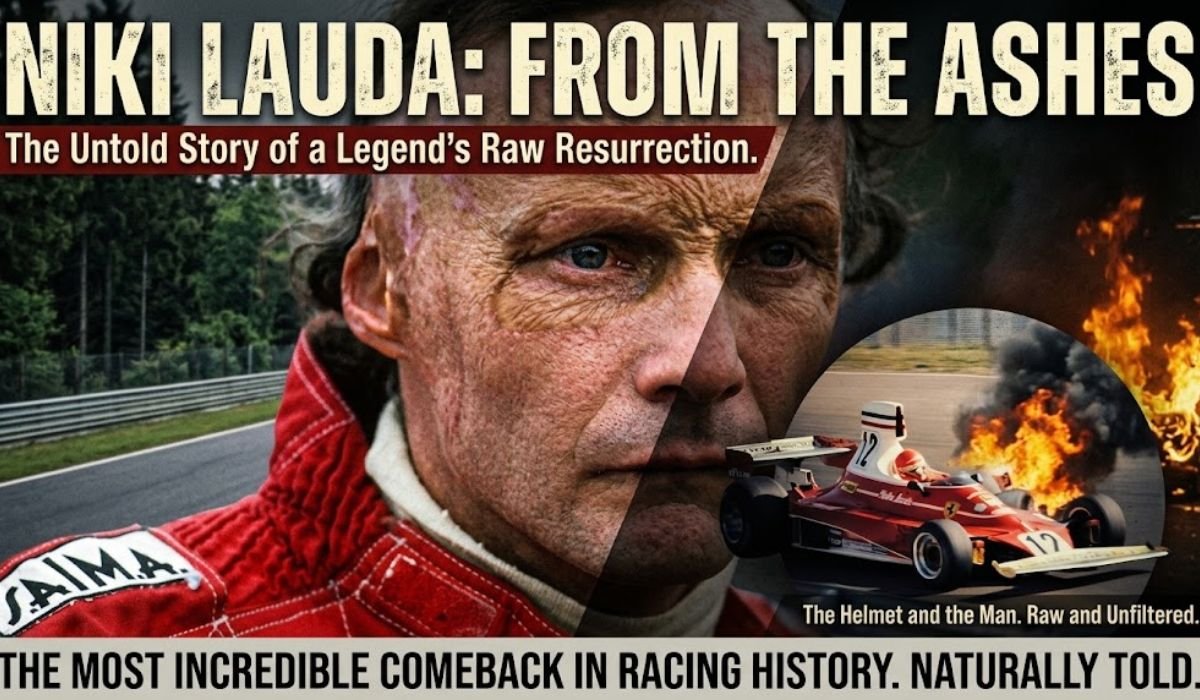
Niki Lauda suffered life threatening injuries during the 1976 German Grand Prix at the Nürburgring on August 1. His Ferrari left the track and struck barriers before becoming engulfed in flames. The accident caused severe burns and serious lung damage, placing his life in immediate danger.
The Nürburgring was a demanding circuit with long sections, challenging corners and limited opportunities for immediate assistance in some locations. Lauda’s accident exposed the dangers drivers faced during an era when safety standards and rescue arrangements differed substantially from those used in modern Formula One.
Who Pulled Niki Lauda From His Burning Car?
Several people contributed to Lauda’s rescue. Fellow Formula One drivers Arturo Merzario, Guy Edwards, Harald Ertl and Brett Lunger were involved in the effort, alongside a track marshal. Merzario is particularly associated with reaching Lauda and releasing his safety harness so he could be removed from the wreckage.
It is more accurate to describe the incident as a rescue effort involving several people than to credit one individual with every part of it. The drivers and marshal faced considerable danger while trying to reach Lauda in the burning car.
The rescue became one of the defining moments in Lauda’s life because the severity of his injuries made his survival uncertain. His return to racing shortly afterward turned the accident into an enduring example of determination and recovery.
What Injuries Did Niki Lauda Suffer?
Lauda suffered extensive burns, particularly to his head and face, as well as severe damage to his lungs from inhaling toxic gases. The injuries required intensive medical treatment and left permanent physical effects.
His recovery involved more than healing visible wounds. Lung damage and the overall trauma of the accident made his return to racing especially demanding. The fact that he competed again within weeks was extraordinary, but it should not be mistaken for a complete recovery from every consequence of the crash.
How Did Niki Lauda Return to Racing So Quickly?
Lauda returned to Formula One at the Italian Grand Prix at Monza on September 12, 1976, approximately six weeks after his accident. He finished fourth, a remarkable result given the severity of his injuries and the short time since the crash.
His comeback was driven by his determination to compete for the championship and his confidence in his ability to race again. The return did not mean the injuries had disappeared. It demonstrated that he was willing to resume competition despite the physical and psychological challenges involved.
Lauda’s recovery is often remembered as one of Formula One’s great comebacks because it combined an unusually short recovery period with a return to the highest level of professional racing.
Niki Lauda and James Hunt: Rivalry and Friendship
Niki Lauda and James Hunt were major competitors during the 1976 Formula One season. Lauda represented Ferrari, while Hunt drove for McLaren. Their contrasting personalities and approaches to racing helped make their championship battle one of the most remembered stories in the sport.
Lauda was known for his analytical style and disciplined preparation. Hunt had a more flamboyant public image. Those differences made their rivalry compelling, but they should not be mistaken for proof that the two men were simply enemies.
Who Won the 1976 Championship?
James Hunt won the 1976 World Drivers’ Championship by one point over Niki Lauda. Lauda had built a strong position before his crash, but his injuries disrupted his season. He returned to racing and remained in contention until the final round.
At the Japanese Grand Prix at Fuji, heavy rain created dangerous conditions. Lauda withdrew because he considered the conditions too risky, while Hunt finished third and secured the championship. The decision reflected Lauda’s judgment about safety rather than a lack of competitive ambition.
Were Niki Lauda and James Hunt Friends?
Yes. Lauda and Hunt had a genuine friendship alongside their fierce professional rivalry. Their relationship was more complicated than the simple opposition often suggested by dramatic retellings. They competed intensely, but their personal relationship did not fit the idea of two men who were permanent enemies.
Their story remains compelling because both drivers were exceptionally competitive and approached racing differently. The 1976 championship brought those differences into sharp focus while demonstrating how professional rivalry can coexist with personal respect.
Niki Lauda Before and After the Crash
Before the 1976 accident, Lauda was establishing himself as one of Formula One’s strongest drivers. His 1975 championship with Ferrari had already demonstrated his ability to combine speed with consistent results.
After the accident, his career took on a different dimension. His injuries became a permanent part of his public story, but he continued competing, won the 1977 championship and later added a third title with McLaren in 1984.
The most important distinction is that the crash changed Lauda’s life without ending his racing career. His later achievements show why a biography focused only on the accident would leave out a substantial part of his legacy.
Why Was Niki Lauda’s Red Cap So Recognizable?
Lauda became closely associated with a red cap that covered much of the scarring on his scalp after the accident. The cap became a distinctive part of his public appearance and an immediately recognizable feature of his image.
His appearance was connected to the serious burns he suffered, but the cap should not be treated as the entire story of his recovery. His medical treatment, continuing health challenges and return to competition were equally significant aspects of his post crash life.
Niki Lauda’s Wife and Family
Niki Lauda’s family life included two marriages. He married Marlene Knaus in 1976, and the couple later divorced. Lauda subsequently married Birgit Wetzinger in 2008.
His first marriage overlapped with his rise to international fame and the period surrounding his serious crash. However, the timing alone does not establish why the marriage ended. Claims about the private reasons for the divorce should not be presented as confirmed unless supported by reliable reporting or direct statements.
Lauda also had children. Family details can help readers understand the person beyond the racetrack, but a responsible biography should focus on established public information rather than speculate about relatives’ private lives.
When Did Niki Lauda Retire From Formula One?
Lauda first retired from Formula One at the end of the 1979 season. He returned to the sport in 1982 and continued racing until his final retirement at the end of 1985.
His retirement history can be confusing because he left the sport, returned after a break and won another world championship. The key distinction is that 1979 marked his first retirement, while 1985 marked the end of his Formula One driving career.
| Year | Career milestone |
|---|---|
| 1975 | Won his first world championship with Ferrari. |
| 1976 | Suffered his serious crash and returned to racing later that season. |
| 1977 | Won his second world championship. |
| 1979 | Retired from Formula One for the first time. |
| 1982 | Returned to Formula One competition. |
| 1984 | Won his third world championship with McLaren. |
| 1985 | Ended his Formula One driving career. |
What Did Niki Lauda Do After Racing?
Lauda remained involved in business and motorsport after leaving competitive driving. He became known for his aviation ventures and continued contributing to Formula One through management and advisory positions.
Niki Lauda’s Aviation Businesses
Lauda pursued aviation alongside his racing career and established airline ventures, including Lauda Air. His involvement in aviation reflected the same interest in technical operations and practical decision making that had shaped his approach to racing.
His business career was a substantial part of his life after driving. It demonstrated that his interests extended beyond the track and that he was willing to apply his knowledge and ambition to another technically demanding industry.
His Later Role in Formula One
Lauda later became a prominent figure in Formula One management, including his role as non executive chairman of Mercedes’ Formula One team. He contributed experience and strategic judgment during a successful period for the team.
His later work helped preserve his connection to the sport long after he stopped driving. Rather than being remembered only as a former champion, Lauda remained an influential participant in Formula One’s competitive and organizational world.
Niki Lauda’s Death and Legacy
Niki Lauda died on May 20, 2019, at the age of 70. His death was widely reported across the motorsport world, and Formula One paid tribute to his achievements as a three time world champion and an important figure in the sport.
Lauda’s legacy rests on several connected achievements: his championships, his technical approach to driving, his recovery after the 1976 crash and his later contribution to Formula One management. Each part helps explain why he remains a significant figure in the history of motor racing.
How Did Niki Lauda Die?
Lauda died in 2019 after experiencing serious health problems in his later years. He had a history of major health challenges, including the lasting consequences of his 1976 accident and a lung transplant in 2018. The exact medical circumstances should be described using reliable reporting rather than assumptions based on his earlier injuries.
His death marked the end of a life that had influenced Formula One across several decades. His achievements continue to be discussed in historical accounts of the sport, especially in relation to driver safety, recovery and championship competition.
Niki Lauda in the Movie Rush
Rush, released in 2013 and directed by Ron Howard, dramatizes the rivalry between Niki Lauda and James Hunt during the 1976 Formula One season. Daniel Brühl portrays Lauda, while Chris Hemsworth portrays Hunt.
The film brings attention to Lauda’s accident, his recovery and the championship battle that followed. Its central historical framework is based on real events, but a dramatic film is not a complete documentary record. Dialogue, timing and selected scenes may be simplified or dramatized to serve the story.
Readers interested in the historical record should compare the film with contemporary race results and reputable Formula One histories. The real story is compelling without assuming that every cinematic detail happened exactly as shown.
Frequently Asked Questions
How many world championships did Niki Lauda win?
Niki Lauda won three Formula One World Drivers’ Championships, in 1975, 1977 and 1984. His first two titles came with Ferrari, and his third came with McLaren.
When did Niki Lauda die?
Niki Lauda died on May 20, 2019, aged 70. He was born on February 22, 1949, in Vienna, Austria.
Who rescued Niki Lauda after the 1976 crash?
Several drivers and a track marshal took part in the rescue. Arturo Merzario is especially associated with reaching Lauda and releasing his safety harness.
Did Niki Lauda and James Hunt become friends?
Yes. Lauda and Hunt were friends as well as fierce championship rivals. Their relationship combined personal respect with intense competition on the track.
Which teams did Niki Lauda drive for?
Lauda competed in Formula One with March, BRM, Ferrari, Brabham and McLaren. Ferrari and McLaren were the teams with which he won his world championships.
When did Niki Lauda first retire?
Lauda first retired at the end of the 1979 season. He returned in 1982 and continued racing until the end of 1985.
What was Niki Lauda’s net worth?
A precise, independently verified figure for Lauda’s personal net worth has not been established by the authoritative sources reviewed. Published estimates should not be treated as confirmed financial records.
Key Takeaways
- Niki Lauda was an Austrian Formula One driver and three time world champion.
- He won the world championship in 1975, 1977 and 1984.
- His 1976 Nürburgring crash caused severe injuries, but he returned to racing approximately six weeks later.
- His relationship with James Hunt combined genuine friendship with fierce competition for the 1976 title.
- Lauda retired from driving at the end of 1985 and later contributed to aviation and Formula One management.
- He died on May 20, 2019, aged 70, leaving a lasting legacy in motorsport.